Locu. Design concept that grew to a real product with emotional value.
From a design thinking exercise to a product in development, launching soon on iOS and Android.
Context
Six years ago I designed the first version of this app as part of a mobile design course. Good UX for a cleaning app. Done.
Came back to it three years later and realised I'd solved the wrong problem. A nice interface doesn't make you want to clean.
I never liked cleaning. Until I noticed that 5 minutes of tidying up actually stopped my brain. Dishes, trash, wiping a surface. Something about using your hands switches something off. Free therapy. But every app I tried made me feel worse before I'd done anything. A backlog at 9pm isn't motivation. It's just more pressure.
So I started over. No brief, no client. Just a question: what if the app felt like rest, not work?
Problem
Cleaning apps borrow from productivity tools: streaks, counters, task lists that never get shorter. That works fine at 10am. At 9pm after a full day, it's the last thing anyone needs.
The problem isn't the features. It's the emotional framing.
Key Insight
The real need isn't a clean house. It's feeling in control at the end of the day.
A short tidy-up in the evening isn't really cleaning. It's a transition. Something physical that marks the end of the day so your brain can actually stop.
Two kinds of people use Locu. Some just want to feel a bit better: open the app, pick a time, go. No planning. Others want a system: custom tasks, reminders for things like changing bed linen, a quiet structure in the background. Same ritual, different grip on it.
How Might We
How might we make opening the app in the evening feel like support, not pressure?
How might we make 5 minutes feel like a real win, not less than a 30?
How might we show progress of inner state, not just tasks completed?
How might we build a habit that feels good to keep, but not scary to miss?
Core Design Decisions
Tasks are hidden until the user picks their time.
First question: how much time do you have? 5, 15, or 30 minutes. Only tasks matched to the duration appear. No visible backlog. You never see everything you haven't done.
5 minutes counts the same as 30.
Showing up every day matters more than doing a lot once a week. One thing done beats a marathon that never happens.
The timer is the ritual container.
Session starts, countdown runs, notifications go quiet. Before cleaning, the user says their intention out loud: "In the next 5 minutes I will take out the trash." The timer turns an open-ended chore into a contained moment.
Progress is visual, not numerical.
The sun has 10 rays. Each day of streak, they get brighter by dimming to full glow over 30 days. No counters. Just a sun coming to life. At day 30: Orbit. After that, the rays start changing colour by cycling through 9 phases. There's always a next step. No finish line.
Low cognitive load.
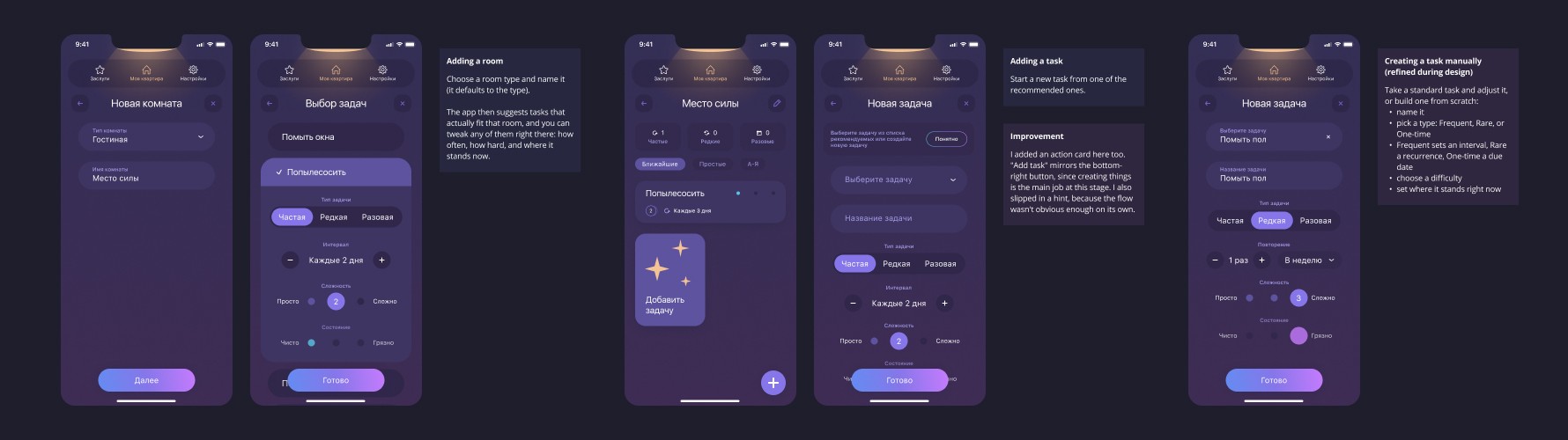
Setup is almost entirely on the app side: a few taps about your home and what you own, and it builds the task list for you. After that, every screen asks for one decision at a time. Nothing piles up. Each session takes almost no thinking.
Learnings
Emotional framing is the product. Locu's feature set is simple. What makes it different is how it makes you feel before you've done anything.
Removing information is a design decision. Hiding the backlog until after the time choice was the most counterintuitive call, and the most important one.
Small mechanics carry big meaning. The sun animation, the intention statement, the paused notifications. None are complex. Together they turn something mundane into something worth doing.
A self-initiated project shows something a client project can't: how you think when no one is watching.
Most apps today are built fast, with AI filling the gaps. And it shows. They work, but they don't feel like anything. Locu is trying to be the opposite. Do for home environment what Duolingo did for language learning.
The app is in development. Marketing campaign is underway. Release coming very soon. 🤞